
1. Vietnamese Arabica Green Beans
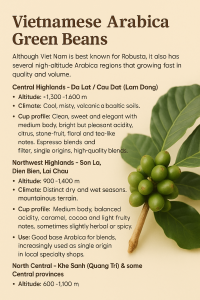
Although Viet Nam is best known for Robusta, it also has several high-altitude Arabica regions that are growing fast in quality and volume.
Central Highlands – Da Lat / Cau Dat (Lam Dong)
-
Altitude: ~1,300–1,600 m
-
Climate: Cool, misty, volcanic and basaltic soils.
-
Cup profile: Clean, sweet and elegant with medium body, bright but pleasant acidity, citrus, stone-fruit, floral and tea-like notes.
-
Use: Specialty espresso and filter, single origins, high-quality blends.
Northwest Highlands – Son La, Dien Bien, Lai Chau
-
Altitude: 900–1,400 m
-
Climate: Distinct dry and wet seasons, mountainous terrain.
-
Cup profile: Medium body, balanced acidity, caramel, cocoa and light fruity notes, sometimes slightly herbal or spicy.
-
Use: Good base Arabica for blends, increasingly used as single origin in local specialty shops.
North Central – Khe Sanh (Quang Tri) & some Central provinces
-
Altitude: 600–1,100 m
-
Cup profile: Chocolate, nutty, mild citrus, gentle spices, with medium body and moderate acidity.
-
Use: Espresso blends and capsule coffee where smoothness and sweetness are important.
2. Main Robusta regions and characteristics
Central Highlands – the heart of Vietnamese Robusta
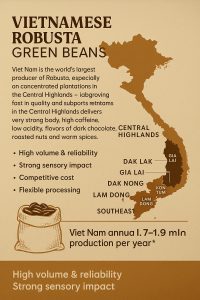
Most Robusta in Viet Nam comes from the Central Highlands, with five main provinces:
-
Dak Lak – often considered the “capital” of Vietnamese coffee.
-
Gia Lai
-
Dak Nong
-
Kon Tum
-
Lam Dong (besides Arabica, Lam Dong also grows significant Robusta).
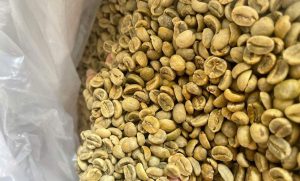
Altitude: ~500–800 m (some areas slightly higher)
Climate & soil:
-
Tropical climate with a marked dry season during harvest.
-
Basaltic, fertile soils ideal for coffee.
Cup profile:
-
Very strong body, thick mouthfeel.
-
High caffeine content (typical Robusta strength).
-
Low acidity, suitable for dark roast styles.
-
Flavour notes: dark chocolate, roasted nuts, cereal, earth, light wood and warm spice; depending on processing, can show cleaner cocoa and nutty tones.
Use in blends:
-
Foundation coffee for espresso, capsule and Vietnamese phin blends.
-
Adds crema, body and bitterness when combined with Arabica.
-
Widely used for instant coffee and 3-in-1 because of its strength and price competitiveness.
Southeast & other Robusta areas
Outside the Central Highlands, Robusta is also grown in:
-
Binh Phuoc, Dong Nai and neighbouring provinces in the Southeast.
-
Some lowland or mid-altitude areas in the South Central Coast.
Cup profile:
-
Still strong and full-bodied, but often simpler and more roasty, with less complexity than highland lots.
-
Ideal as bulk Robusta to support large-scale soluble and blend production.
Why Vietnamese Robusta is attractive for buyers
You có thể gói lại thành 4 bullet chính để dùng trong catalogue:
-
High volume & reliability – World’s leading Robusta origin, suitable for long-term contracts and industrial production.
-
Strong sensory impact – Very full body, strong caffeine, low acidity, flavours of dark chocolate and roasted nuts, ideal to build the backbone of espresso and instant blends.
-
Competitive cost – Efficient farming and logistics make Vietnamese Robusta price-competitive versus many other origins.
-
Flexible processing – Available in a range of grades and processes (natural, washed / semi-washed, screen sizes, moisture and defect specifications) to match different quality and price segments.
Position in the world 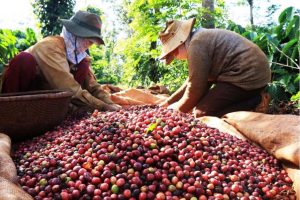
-
Viet Nam is the world’s largest producer of Robusta coffee, and usually the second-largest coffee exporter
-
overall (after Brazil).
-
Robusta accounts for roughly 90–95% of Viet Nam’s total coffee production; Arabica is only a small share in comparison.
-
Vietnamese Robusta is a key raw material for espresso blends, instant coffee and 3-in-1 products in Europe, Asia
-
and many other markets.
(You can phrase it simply in marketing materials as: “Viet Nam is the world’s number one Robusta producer and a key global supplier of high-quality Robusta green beans.”)